Walking into the winter showcase of the newest 2026 Dodge Charger Sixpack R/T , I expected the usual muscle car drama, but what I got felt like a plot twist. Set deep in the Appalachian mountains of northern New England, at the Team O’Neil Rally School, this first drive wasn’t about clean pavement it was about snow, mud, and freezing conditions. We pushed this full-size sedan through crusty roads, over frost heaves, across miles-long stretches of forested trails that felt more like a rally stage than a press event. In this environment, surrounded by car people, the story quickly shifted from traditional muscle expectations to something more rugged.
The two-door and four-door layout options hint at versatility, but out here, it felt like a performance car designed for the worst place that somehow becomes the best place to understand it. This wasn’t just a car review, it was a raw experience shaped by snow-covered terrain, challenging roads, and true winter testing.
Underneath, the engine tells another story. The 3L Hurricane I6 ICE replaces the old V8 narrative, delivering 420-horsepower, or simply 420 HP, backed by 469 lb-ft of torque hitting between 3500 RPM and 5200 RPM. Paired with an 8-speed automatic transmission and an all-wheel drive drivetrain (AWD), the powertrain feels tuned for all-weather performance rather than straight-line bragging.
Through icy roads and rugged conditions, traction and handling stood out, though the bumpy ride, noisy ride, and narrow footwell reminded me this isn’t perfect. As a driver, I noticed the interior still leans traditional with physical buttons, but limited visibility from the sides and rear can make it feel like a fish-out-of-water in tight spots. Still, the blend of SUV space, surprising practicality, and all-season usability makes this automotive sedan unique in its segment.
- pros: looks, fast, standard output I6, strong traction, confident snow driving, impressive handling in terrain, usable SUV space, solid practicality, dependable all-weather capability
- cons: bumpy ride, noisy ride, narrow footwell, limited visibility from sides and rear, slight comfort compromises, some usability concerns in tight spaces
Covered in dirty photos of mud and snow, this test proved the theory: this make and model redefines what a modern muscle car can be when pushed through extreme conditions. At the rally gates of the mountains, facing unpredictable terrain, it builds a unique brotherhood between machine and driver, something you don’t expect from a full-size sedan, yet something this performance car delivers with surprising confidence.
More Than Just a Nameplate
Starting with the volume model, the Dodge Charger Sixpack R/T sits in a sweet spot that feels carefully calculated. It’s not the hottest version like the Scat Pack, and it doesn’t chase the high-output drama of a Scatty, but that’s exactly the point. This performance sedan comes in both four-door and two-door body style, giving buyers real choice without changing the core experience.
The starting price undercuts expectations by about five grand, making it a lower price entry into what still feels like a premium automotive segment. From my perspective, this balance makes it the new Charger most people will actually live with not just admire. The back seat access is easier in the four-door, but both versions share the same interior layout, with identical layout, identical dimensions, and even an identical wheelbase, which keeps the experience consistent across model variants.
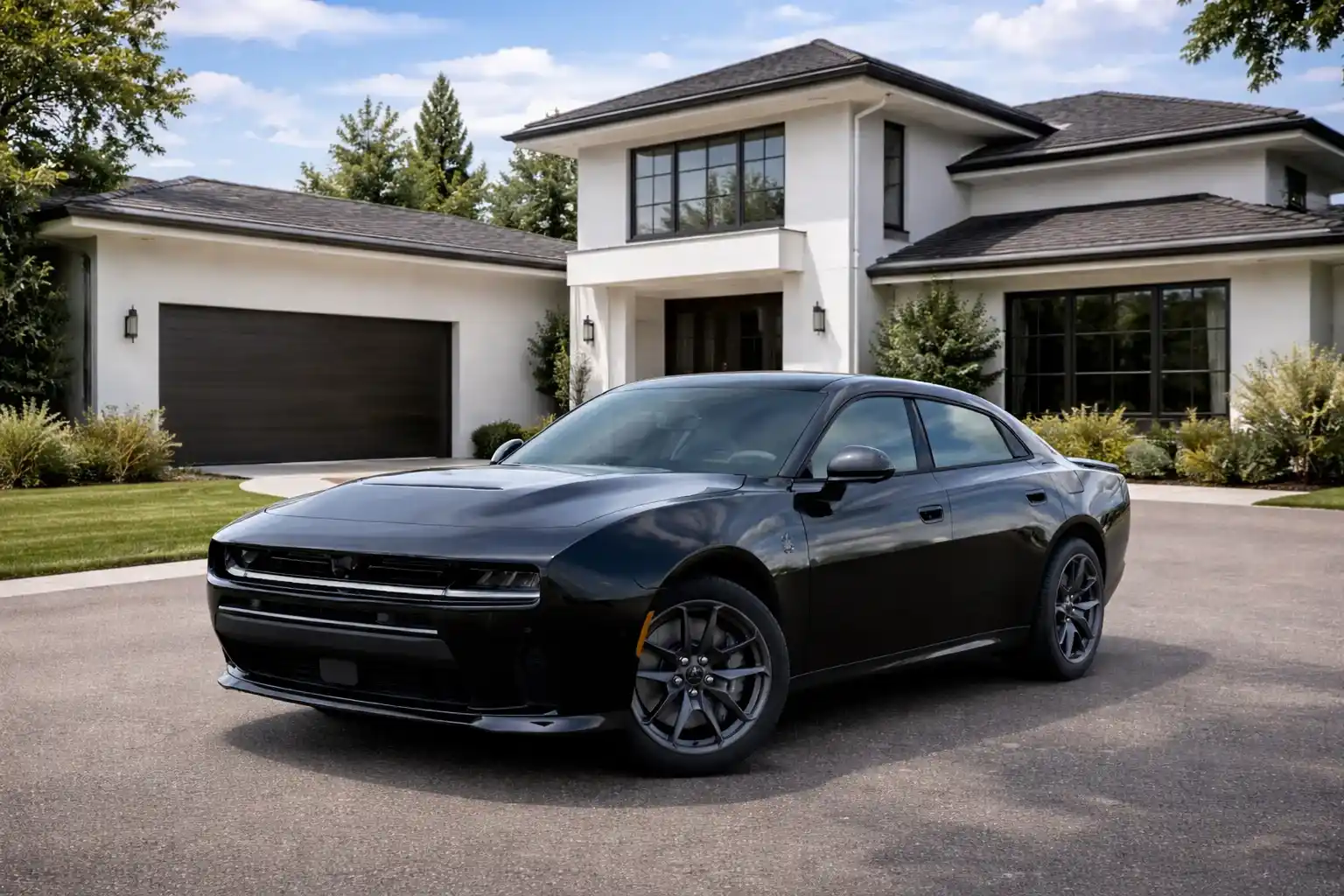
What really surprised me is how big this thing feels in real life. This is not a small car, it’s a proper full-size sedan, sitting firmly in the large car category. In a quick size comparison, it’s only a few inches shorter than a Ford Crown Victoria, yet noticeably wider, which gives it strong road presence and confident proportions. Built on a modern platform, the design leans into bold stance and usable space, making passenger access and overall practicality feel like priorities, not afterthoughts.
Looking at the dimensions comparison, you can tell this focuses on real-world usability as much as style. Whether you pick the two-door for its sleekest form or the four-door for daily comfort, the model delivers a consistent identity one that quietly redefines what a modern performance sedan should be.
Exterior Looks: Badass From Every Angle
Starting with the exterior, the Dodge Charger instantly sets a tone that feels both modern and rooted in history. The clean lines and straightforward design give it a confident base, while the aggressive vibe adds the kind of swagger you expect from a true muscle car styling icon. What stood out to me after a few miles of driving experience was how the design language avoids overdoing things. There’s just enough retro influence, with subtle throwbacks to 1968, without falling into gimmicky branding.
The Sixpack branding and even some hood branding might feel slightly cheesy at first glance, but they grow on you as part of the car’s brotherhood identity, especially for fans who still miss the V8 era. The long big hood with its power bulge, paired with a sleek roof and fastback sweeping roofline, creates a strong sense of motion even when parked, making the R/T model even as an entry trim feel anything but basic.
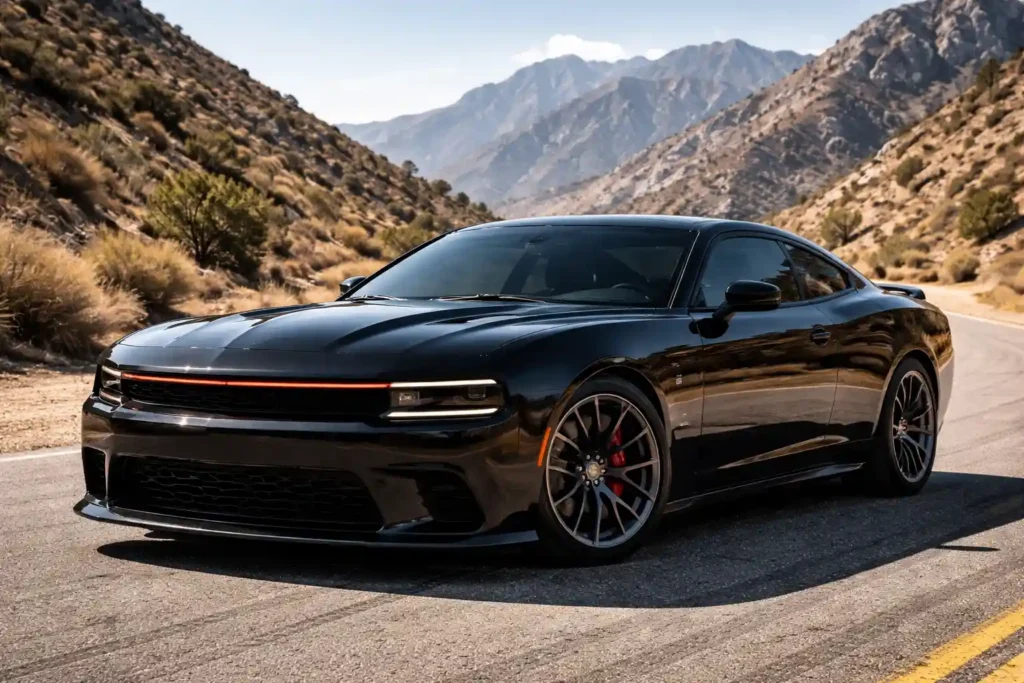
- Strengths: looks amazing, bold wide stance, confident stance, sharp body lines, strong visual appeal, clean yet aggressive design, balanced two-door proportions, distinctive lighting signature, tasteful retro with classic inspiration, well-executed modern design
- Weaknesses: slight awkward proportions in some angles, hints of gimmicky branding, Sixpack branding and hood branding can feel cheesy, less dramatic than Scat Pack, lacks some Widebody aggression
From a design perspective, the proportions are where things get interesting. The two-door proportions look more natural and balanced, while the four-door carries a slightly different character but still holds a wide stance that hints at widebody presence. Compared to the Scat Pack, this version keeps things cleaner, avoiding excessive vents and focusing on distinctive styling through contrasting angles.
The front lights and rear lights form a unique lighting signature that enhances its visual appeal, especially at night. With multiple wheel options and carefully placed badges, the overall ambiance feels cohesive, making this one of the best-looking entries in its category while staying true to its evolving muscle car styling roots.
Interior: Big Space, Bigger Attitude
Starting with the space to spare, the cabin of the R/T immediately feels designed for real life, not just style. There’s generous cabin space, smart storage, and enough room for actually carrying people and carrying things without compromise. The back seat offers true adult space with easy access, and the wide-opening rear hatch boosts cargo capacity by 127% compared to the old Charger, which seriously improves practicality and everyday usability. The seats are genuinely comfortable seats, and even after long drives through rural roads like those in northern Vermont, I didn’t feel fatigue.
The overall interior design carries a distinctive style with an aggressive style, blending a muscular vibe with clear Dodge identity. The retro-themed dash, flowing across the passenger side, is enhanced by Attitude Adjustment lighting, including colored lighting and a dramatic 270-degree lighting setup across the dash and doors, giving the modern interior a bold personality that mirrors the exterior styling and even echoes hints of the Scat Pack.
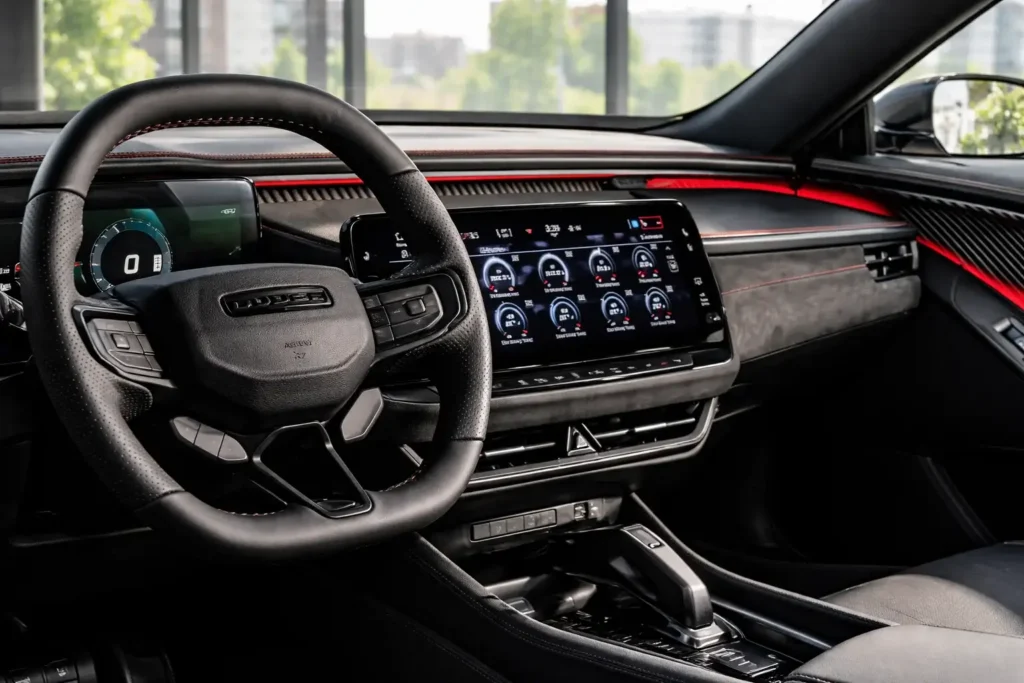
- Strengths: spacious cabin space, smart ergonomics, large rear space, practical rear hatch, strong cargo capacity, intuitive screen positioning, clear readability, solid technology and connectivity, responsive user interface, seamless smartphone integration
- Weaknesses: not enough buttons, noticeable lack of physical controls, over-reliance on haptic touch, some usability issues in touch interface, tight narrow footwell and driver footwell, occasional limited visibility despite otherwise better visibility balance
Tech is where things feel both impressive and slightly frustrating. The dashboard layout is dominated by a 10.25-inch display or optional 16.0-inch optional display, paired with a 12.3-inch center screen and configurable driver display. These center screens use a clean landscape display format with excellent easy access and minimal distraction, letting you jump between settings, applications, and performance pages with clear gauge readouts.
Running on the Uconnect 5 operating system, the system supports wireless CarPlay, Android Auto, Alexa integration, and TomTom navigation with integrated navigation that proved useful on remote drives where the native nav system and driver display integration really shine. Add in an optional HUD (heads-up display), and the infotainment experience feels complete. Still, the lack of physical controls for climate functions, often buried behind a strip of plastic interface, can hurt usability.
On the plus side, the shift lever for the eight-speed automatic uses a pistol grip throwback design that adds a real cool factor, tying the whole modern interior back to its heritage.
Power That Feels Bigger Than It Reads
Starting with real-world driving, the R/T version of this Dodge feels more honest than the numbers suggest. On paper, the powertrain uses a twin-turbocharged 3.0-liter Hurricane I6 in standard-output form, making 420 hp clearly less power than the high-output Scat Pack with its 550 hp. But out on back roads and twisty roads, it delivers a surprisingly satisfying and muscular feel. The key lies in the engine tuning, where smaller turbos in the SO engine help reduce turbo lag, giving a more quick response when you press the skinny pedal.
You still feel a bit of peaky power higher up, but the strong low-end power and torque rated at 468 pound-feet with peak torque hitting around 2,500 RPM make everyday driving feel effortless. Paired with an eight-speed automatic transmission, the shifts are smooth, especially in Auto mode, while Sport mode sharpens the throttle and acceleration for more engaging performance.
- strengths: strong low-end power, smooth transmission, confident all-wheel drive, excellent traction, balanced handling, good weight management, solid real-world usability, impressive acceleration feel, stable drivetrain, capable on muddy roads and rough terrain
- weaknesses: noticeable understeer at the limit, some road noise, occasional rough ride, slight turbo lag, peaky power delivery at higher revs
Where it really surprised me was in tough conditions. Through New England frost heaves and rough conditions, the suspension in its softest mode delivered a fairly compliant ride, making long road trips comfortable despite the car’s size. Push harder, and the sedan shows its weight, but the excellent AWD system and overall drivetrain tuning keep things controlled, even allowing a bit of opposite-lock fun on loose surfaces without losing stability.
The engine performance builds nicely into a strong high-end pull, easily pushing past 100 mph, with claimed 0-60 mph in 4.6 seconds and a quarter-mile in 12.9 seconds. It’s not just about straight-line speed, it’s about how usable that horsepower feels in everyday situations, delivering a balance of comfort, responsiveness, and confidence across changing road conditions.
2026 Dodge Charger Sixpack Engine Options
Starting with the engine options, the 2026 Dodge Charger Sixpack lineup takes a modern route that feels smarter the more you drive it. The R/T runs a SO twin-turbocharged 3.0L inline six I6, producing 420 hp and 468 lb-ft of torque, while the Scat Pack upgrades to a HO twin-turbocharged version with 550 hp and 531 lb-ft. Both setups use an eight-speed automatic transmission and a standard all-wheel drive drivetrain (AWD), but what stood out to me is the clever RWD-only mode where you can disengage the front axle and enjoy true rear-wheel drive behavior.
On paper, the numbers are quick: 0-60 in 4.6 seconds for the R/T and 3.9 seconds for the Scat Pack, with top speed figures of 127 MPH and 177 MPH. Fuel economy is still listed as N/A, though expected figures hover around 16 mpg city, 23 mpg highway, and 19 mpg combined, which makes sense given how big and heavy this performance sedan feels in motion.
- R/T: 420 hp, 468 lb-ft, smoother power, better balance for daily performance and usability
- Scat Pack: 550 hp, 531 lb-ft, stronger horsepower, sharper acceleration, more aggressive feel
- Shared hardware: AWD system, selectable RWD mode, advanced drivetrain, multiple driving modes like Sport mode, Snow mode, Mud mode
Out at the Team O’Neil Rally School, the real character came alive in an automotive rally environment where a bit of controlled tomfoolery is actually encouraged. Despite being big and heavy, the car doesn’t just go straight ahead; its handling improves when you trust the control systems.
On a skidpad covered in snow and ice, or any slippery surface, the mix of stability systems, yaw systems, and traction management keeps things predictable. Dial back the stability assists, switch into Sport mode, and the car allows playful drift and sideways movement across all four wheels or just the rear in RWD mode.
- strengths: strong control, confident turning, balanced vehicle dynamics, excellent traction, adaptable in winter conditions, smart tech integration
- weaknesses: noticeable weight in tight handling, requires trust in control systems during a dangerous situation, can push limits if you ignore safety and minimize risk principles
The blend of smart driving modes and advanced control systems makes this setup feel less intimidating and more usable, even when pushing boundaries in low-grip environments.
Verdict & Pricing: A Legit All-Season, Family-Sized Fun Car
Starting with pricing, the Dodge Charger Sixpack lineup lands in a surprisingly smart place for what it offers. The starting MSRP begins at $49,995 (plus $1,995 destination, totaling $51,990), placing it right around the average new car price and firmly in an affordable range for many SUV buyers. Looking at full model pricing, the Charger Sixpack R/T 2 door starts at $49,995, the Charger Sixpack R/T 4 door at $51,995, while the Charger Sixpack Scat Pack 2 door and Charger Sixpack Scat Pack 4 door come in at $54,995 and $56,995.
That’s strong market positioning, especially when you compare it to rivals like a Mustang competitor, or even higher-end options like the BMW 8 Series and Audi RS 7, where you get a bigger size for a cheaper price with a similar performance profile. At this $50,000 price point, it feels like a deliberate rebrand aimed at new customers, not just Hemi heads holding onto the past.
What makes this verdict interesting is where the car proved itself in an unlikely place during a snowy showcase, far from smooth roads. It’s not just a cool car or a fast car, it’s genuinely a fun car that works whether you’re single, married, or have a kid. With real all-season strength, this family-sized machine handles whatever Mother Nature throws, from mild commutes to wild winter driving across back roads and even rally stages.
- Strengths: true all-wheel drive (AWD) with snow mode, strong bad weather capability, roomy rear-seat passengers area with 37.2 inches legroom (just one inch less than Jeep Grand Cherokee), practical hatch with 22.7 cubic feet cargo space (5 cubic feet more than Dodge Durango seats up), excellent practical car usability, easy driving, confident intimidating presence, real family car appeal, usable four-door layout, genuine year-around car, no compromise blend of fun vehicle and function
- Weaknesses: still not a two-row SUV or family SUV, some buyers may prefer traditional SUV height, shift away from traditional muscle car identity may not suit all Hemi heads
This is where the plot twist lands: it quietly becomes a real replacement for a two-row SUV, even though it’s clearly not an SUV it’s still a sedan or coupe at heart. Compared in any SUV comparison, it delivers similar space and usability while keeping the soul of a traditional muscle car alive. Against the old Charger, this new generation feels like a different animal, less raw, more refined, yet more capable. It’s a performance sedan that doesn’t punish you daily, a family car that doesn’t feel boring, and a machine that proves you can have no compromise enjoyment in a single package.
After spending time with it in harsh conditions, one thing becomes clear: this is a fun vehicle built for real life, and truly, no Hemi required.